

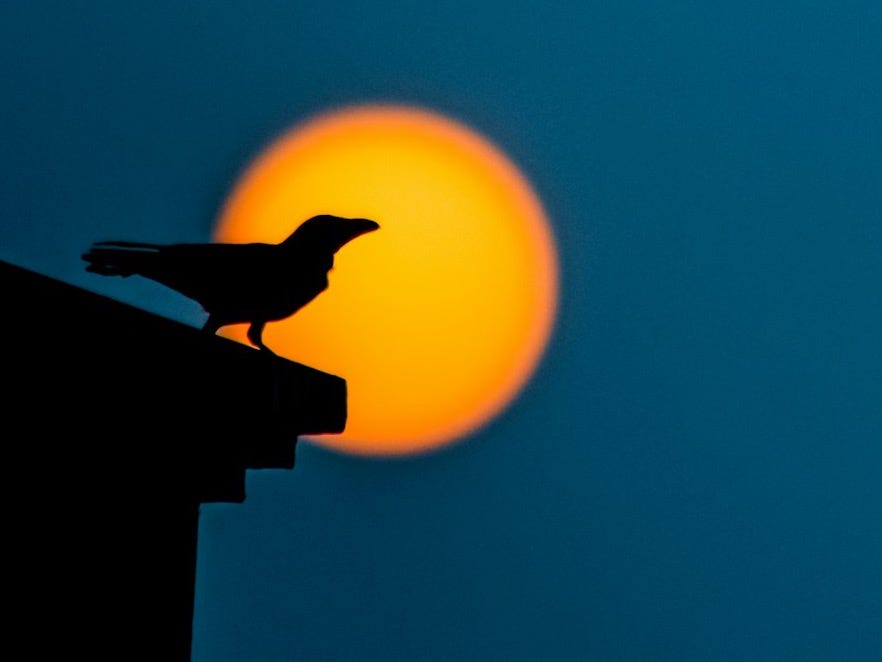
As the Crow Flies...
...more early pages from by work-in-progress, Good Enough Writer: A Guide for the Outsiders, the Misfits, and the Beautifully Complicated
Dear Friends,
Welcome back to my series featuring my book-in-progress, Good Enough Writer: A Guide for the Outsiders, the Misfits, and the Beautifully Complicated. These are early pages for my subscribers, although I tell Substack to leave enough open for everyone to enjoy.
Do we enjoy early drafts? Not sure. They’re definitely an adventure.
If you want to see some other pages from the book, I posted a chapter titled Chrysalis a couple of weeks ago. That was the start of this series.
I’m not sure how this book will look when I’m finished, but my deadlines here, for you, are helping me stay on track. So thank you.
But first, here are some of my recent publications you might want to check out:
My flash essay/prose poem “The Other Guys” appeared in the latest issue of The Coachella Review. They publish lovely work, and I’m so pleased to be included. It’s about childhood, the power of memory, and bluefish.
My craft essay “Record First, Write Later” appeared in the Brevity Blog. Thank you to Andrea A. Firth for your always-excellent editing.
And now, on to the main event.
Part I. As The Crow Flies
[NB: This might not be Part the first in the final draft. It could be second or whatever. But it is the first “Part” I’ve written.]
Chapter 1. Persistence
[NB: Same, but for chapters.]
This Part was inspired by a question I frequently receive from readers and aspiring authors: But how did you get here?
Buried inside the question is hope. They want to know if they can get here, too.
Here: A published author, but one who took an unconventional path.
They don’t know that I frequently lost my way. That a winding path can be good, because experience is the foundation of every story, poem, book, essay. Experience gives us things to write about. It’s simple, really.
But why ask me? I’m not on any lists. Not notable. Barely successful in the world of writing. I’ve hardly won the author lottery and have no secrets to help you do so, either.
Perhaps that very lack of success makes my advice more accessible. My career seems more attainable. Whatever the reason, it is a question I’m happy to answer.
This is a chronological journey covering decades, with nothing ugly hidden. If you want to know how this author makes a living as a writer, you will learn it. If you want to know what happens when your confidence fails you, when you lose hope and yourself, that is here too. If the story could be summed up in a word, it would be persistence. James Baldwin once told an interviewer about talent vs. persistence in writing, “I know a lot of talented ruins. Beyond talent lie all the usual words: discipline, love, luck, but most of all, endurance.” [https://www.themarginalian.org/2016/02/08/james-baldwin-advice-on-writing/]
This is a story about endurance. Mine, yes, but also yours.
***
Chapter 2. Isolation
As a prologue to my undergraduate years, I want to say that I severely disliked college, and Duke University in particular. Those of us who graduated from Duke and didn’t like it are a minority, but we have good reasons for our opinion.
One of them is that Duke, more than any other college I’ve encountered in all of my years in higher education, has an extremely narrow path of socially acceptable behavior. You are in, or you are out.
If you are neurodivergent, you are much more likely to be on the outside, like I was. Finding others who are out with you and building a social group when the majority of the college community tells you that you are wrong is not easy. I failed. The task took a degree of self-possession that I didn’t have as an undiagnosed autistic girl.
As a child, I never learned the sense of self-worth that I would have needed to survive college unscathed—quite the opposite. When I was younger, for as long as I can remember until I stepped onto Duke’s campus, I was told I was socially inept and worthless.
Many neurodivergent people share this same experience, which is why we learn to mask so young. As psychologist Devon Price writes, “Autistic people are born with a mask of neurotypicality pressed against our faces.” [Devon Price, Unmasking Autism: Discovering the New Faces of Neurodiversity (New York: Harmony, 2022), 8.]
Masking, also called “social camouflaging,” helped me survive as a child and as a college student, but it had a cost. I came across as stuck up and cold (because I never wanted to say the wrong thing), and it was hard for me to make friends because trusting people with the real me felt too risky.
And I was right to be afraid. The first close friend I had in college, I met during orientation. I thought we would be friends for life. We created worlds together with late-night talks over coffee about books and immense ideas. When she abandoned me after our freshman year for sorority life, she left me bereft. I never had a relationship with a friend so close after that. There were other friends as the years passed, but that unique bond? I never found it again, not at Duke. Not for years.
Maybe not ever.
When I was a freshman in college, the world felt immense and full of possibilities. She was part of that immensity. When she left, my world grew a little bit smaller.
A few things went well in college, and one of them was the creative writing workshops I enrolled in. Before arriving on campus, I didn’t even know such courses existed. A workshop? What did that even mean?
The point is, I was beyond ignorant about how writers became writers.
